[ez-toc]
Overview
- Software package for assembling fault-tolerant control systems based on software
- Designed for control systems with single-channel distributed I/O
- For use in applications with low demands on changeover speed, such as the control of hydroelectric power plants, cooling circuits, traffic flows, level control, measured data acquisition
- Inexpensive thanks to the use of standard S7-300 and S7-400 components
- I/O linking with PROFIBUS DP in redundant configuration
- Optional control via WinCC operator station
Application
The "Software Redundancy" software package allows high availability PLCs to be set up cost-effectively with standard S7-300 and S7-400 hardware components.
Software redundancy can be used for applications that do not have high requirements on switching speed, e.g.:
- Control of water works or water treatment plants.
- Control of cooling circuits.
- Monitoring and control of traffic flows.
- Monitoring/control of temperature or levels.
Depending on the application, redundant design of the entire process or just parts of it is possible.
The following failures are managed:
- Failure of redundant components (PROFIBUS DP master interface, power supply) in a central unit.
- Failure of a CPU due to hardware or software errors.
- Interruption of redundancy connection between the two central devices.
- Interruption of one of the redundant PROFIBUS DP connections to the distributed I/O.
Design
A control system with redundancy is assembled as follows using the Software Redundancy package:
- Two S7-300 (CPU 313C-2 DP, CPU 314C-2 DP, CPU 315-2 DP, CPU 316-2 DP, CPU 318-2 DP or higher) or S7-400 (master and reserve, all CPUs) central controllers, can also be used in combination;
user program and software redundancy program package on both devices
- Single-channel distributed I/O, switched, comprising ET 200M distributed I/O devices with two IM 153-2
- Redundant linking of the central controllers:
Via MPI, PROFIBUS DP or Industrial Ethernet; existing communication links can be used.
- Optional:
Non-redundant I/O, central or distributed
- Optional:
WinCC operator station for user-friendly operator control and monitoring of the redundancy functions (WinCC picture block included in the supply)
Function
Software redundancy:
- Automatic switchover from failed central controller (master) to standby central controller.
Operation with WinCC operator station:
- Request switchover
- Switch redundancy on/off (activate/disable switchover)
- Display status of redundant coupling
- Display status of ET 200M slaves
Mode of operation
In the event of a fault, the "software redundancy" package initiates a switchover from the master central controller to the standby:
- During switchover:
no effect on process since the controller outputs remain frozen
- Following switchover:
continuation of process based on last data received. Data may be several cycles old, therefore only useable for slower processes.
The switchover time between failure of the master and continuation of the process on the standby controller depends on several factors:
- Communication performance of the CPUs used
- Communication medium for master/standby coupling, type of connection and transmission rate
- Quantity of data to be transmitted
- Cause of fault
- Transmission rate of redundant PROFIBUS DP
- Number of slaves on the redundant PROFIBUS DP
For example, the following switchover times result for a system comprising two 414-2 DP CPUs and four ET 200 stations with 4 KB data to be transmitted:
- If the CPUs are coupled via PROFIBUS DP: 1.2 s.
- If the CPUs are coupled via MPI: 1.5 s.
6ES7862-0AC01-0YA0
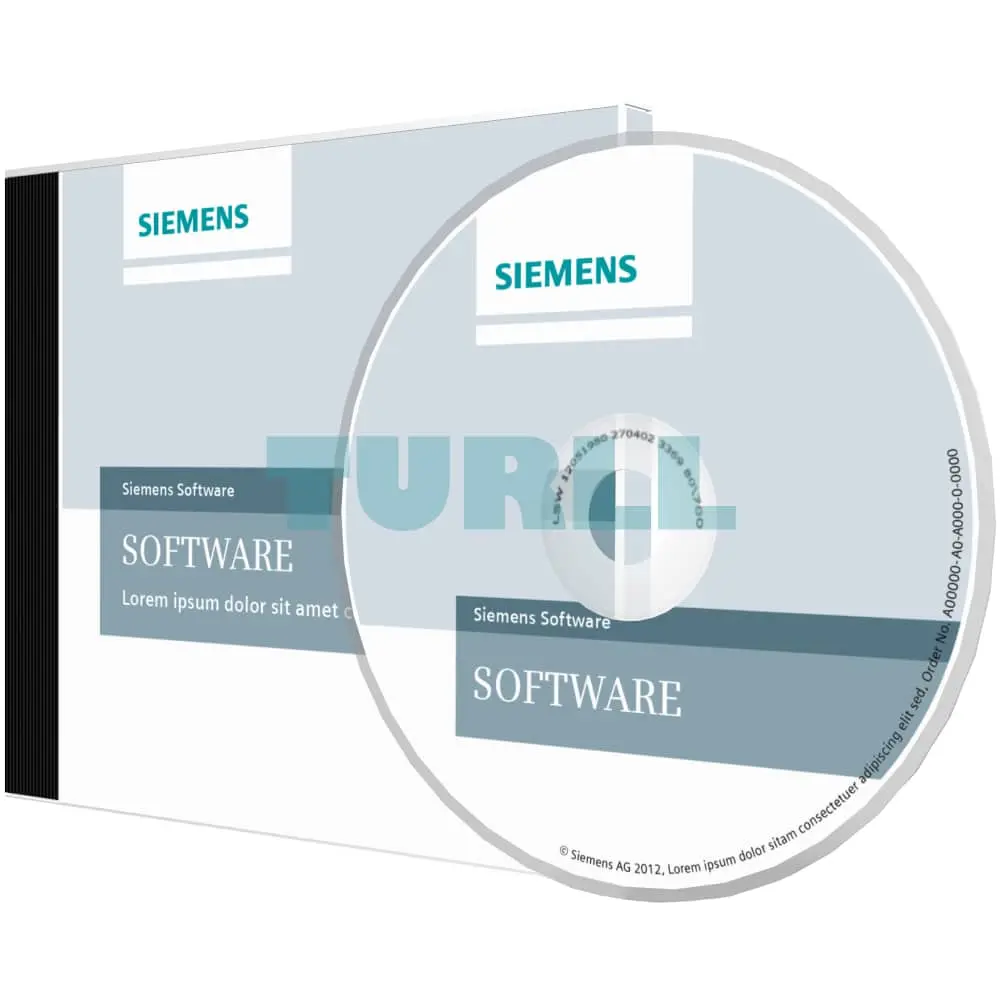
Siemens SIMATIC S7, SW redundancy V1.2 single license for 1 installation R-software (for two CPUs), SW and documentation on CD, Class A, 5 languages(de,en,fr,es,it) Executable in Win95/98/ME/ Windows NT/2000 Prof., Reference HW: SIMATIC S7-300/400 CPU 315 and higher
Visit 6ES7862-0AC01-0YA0
For more our products visit turll.com