[ez-toc]
Overview
- CPUs for high demands in the mid-level performance range
- Applicable for plants with additional demands on programming scope and processing speed
- Integrated PROFINET functions in CPU 414-3 PN/DP
Application
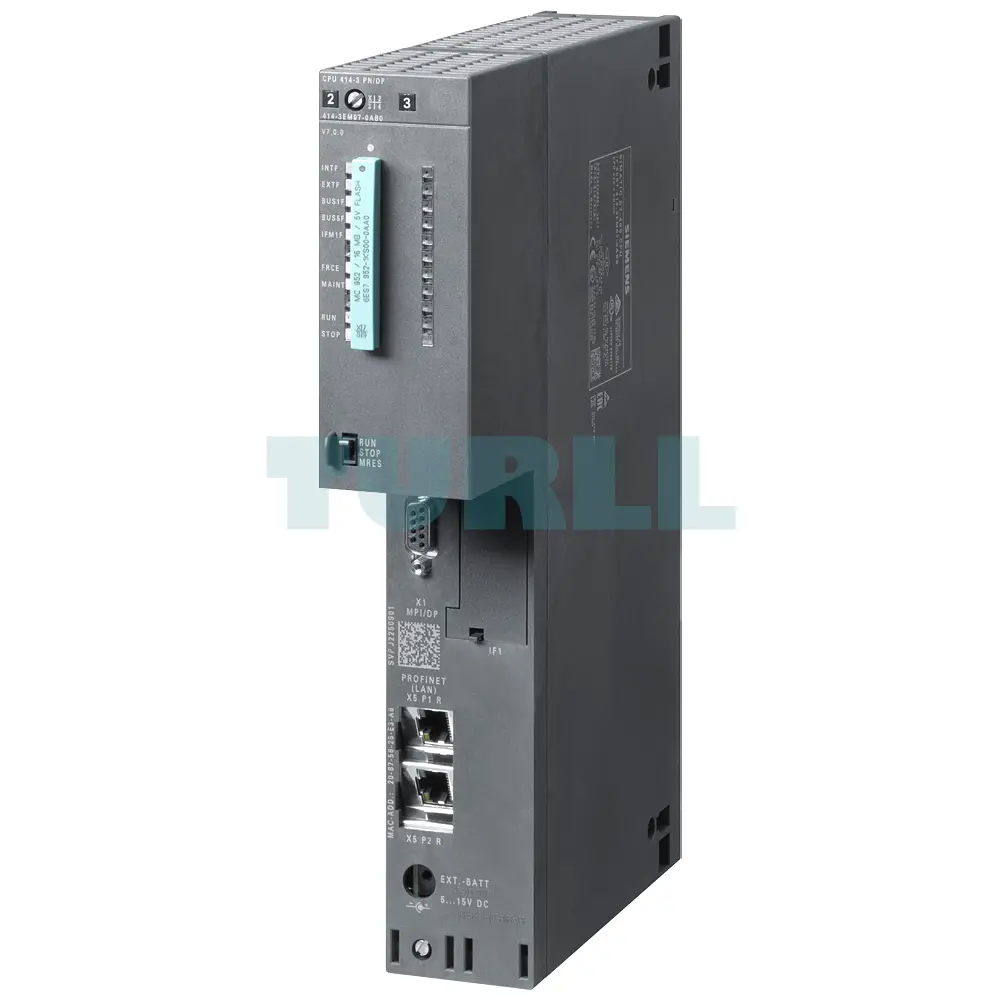
CPU 414-2, CPU 414-3 and CPU 414-3 PN/DP are designed for high demands in the mid-level performance range. They meet higher demands for program scope and instruction processing speed.
The integrated PROFIBUS DP ports in the CPU 414-2 and CPU 414-3 make it possible to connect directly to the PROFIBUS DP fieldbus as a master or slave.
An additional DP master system can be connected to the CPU 414-3 and CPU 414-3 PN/DP using the IF 964-DP interface module.
For the PROFINET interface of the CPU 414-3 PN/DP, the switch functionality permits the formation of two externally accessible PROFINET ports. This means that apart from hierarchic network topologies, line structures can also be implemented with the new S7-400 controllers.
Note:
Only the 6ES7964-2AA04-0AB0 interface module may be used.
Design
The CPUs are equipped with the following:
- Powerful processor:
The CPUs achieve instruction execution times as low as 0.045 µs per binary instruction. - CPU 414-2 : 2 MB main memory (of which 1 MB each for program and data);
CPU 414-3: 4 MB main memory (of which 2 MB each for program and data);
CPU 414-3 PN/DP: 4 MB main memory (of which 2 MB each for program and data);
fast main memory for parts of the user program relevant to execution. - Flexible expansion:
Up to 131072 digital and 81932 analog inputs/outputs. - Multi-point interface MPI:
With the MPI it is possible to establish simple networking of max. 32 stations at a data transmission rate of up to 12 Mbps. The CPUs can establish up to 32 connections to stations of the communication bus (C bus) and the MPI - Mode selector switch:
Designed as toggle switch. - Diagnostics buffer:
The last error and interrupt events are retained in a ring buffer for diagnostic purposes. The number of entries can be parameterized. - Real-time clock:
The date and time are appended to diagnostic messages of the CPUs. - Memory card:
For expansion of the integrated load memory. The information in the load memory comprises S7-400 parameterization data in addition to the program and therefore requires twice as much memory space. The result is:- The integral load memory for large programs is not sufficient, therefore a memory card is frequently required. RAM and FEPROM cards (FEPROM for retentive storage) are available.
- PROFIBUS DP interface and combined MPI/DP interface:
The PROFIBUS DP master interface allows a distributed automation configuration offering high speed and ease of use. From the user’s point of view, the distributed I/O is treated as central I/O (same configuring, addressing and programming).
Mixed configuration: SIMATIC S5 and SIMATIC S7 as PROFIBUS master according to EN 50170.
CPU 414-3 and CPU 414-3 PN/DP also include:
- Additional module slot:
Using the IF 964-DP interface module, an additional PROFIBUS DP master system can be connected.
CPU 414-3 PN/DP additionally includes:
- PROFINET interface with 2 ports (switch):
- PROFINET IO, 256 IO devices can be connected
- PROFINET CBA
Function
- Block protection:
A password concept protects the user program from unauthorized access. - Integral HMI services:
The user only has to specify the source and destination of the data with HMI devices; the data are then transported cyclically and automatically by the system. - Integrated communications functions:
- PG/OP communication
- Shared data communication
- S7 standard communication
- S7 Communication
CPU 414-3 PN/DP additional:
- Open communication over TCP/IP, UDP and ISO-on-TCP (RFC1006)
- Distributed intelligence in Component Based Automation (CBA) on PROFINET
- Additional diagnostic options with integrated webserver
- Firmware update using network
Parameterizable attributes
The STEP 7 tool “Hardware Configuration” can be used to program the properties and response of the S7-400 including the CPUs, e.g.
- Multi-point interface MPI:
- Definition of station addresses.
- Startup/cycle behavior
- Stipulation of the maximum cycle time and communications load
- Address assignment:
Addressing of I/O modules. - Retentive ranges:
Definition of the number of retentive bit memories, counters, timers, data blocks and clock memories. - Size of the process image, local data.
- Length of the diagnostics buffer
- Protection level:
Definition of access authorization for program and data - System diagnostics:
Definition of the handling and scope of diagnostic messages - Timed interrupts:
Setting of periodicity
CPU 414-3 PN/DP additional:
- PROFINET Interface
- Parameterization of time synchronization using NTP procedure
Indication and information functions
- Status and error indicators:
LEDs indicate internal and external errors and operating states such as RUN, STOP, Restart, Test function, for example. - Test functions:
The programming device can be used to display signal states in program execution, modify process tags irrespective of the user program, read out the contents of stack memories, run separate program steps and inhibit program components. - Information functions:
The programming device can be used to provide the user with information on the memory capacity and operating mode of the CPU and the current utilization of the working and load memories
6ES7414-3EM07-0AB0
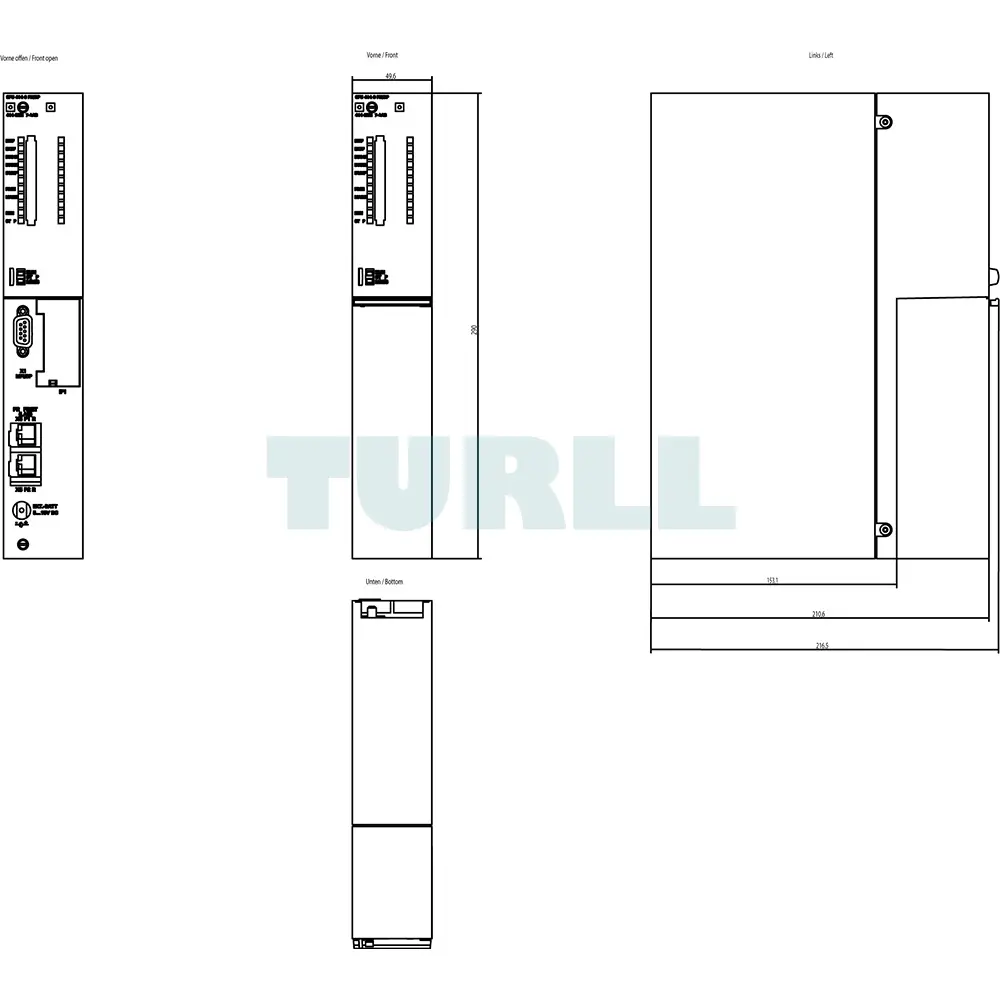
Siemens SIMATIC S7-400, CPU 414-3 PN/DP Central processing unit with: Work memory 4 MB, (2 MB code, 2 MB data), interfaces 1st interface MPI/DP 12 Mbit/s, (X1), 2nd interface Ethernet/PROFINET (X5) 3rd interface IF 964-DP plug-in (IF1)
Visit 6ES7414-3EM07-0AB0
For more our products visit turll.com


Reviews
There are no reviews yet.